Storygrounds: Webtoons, Comics
- 4.8
- Rating
- 10.00K
- Installs
- Free
- Price

 Analysis by App-foxy
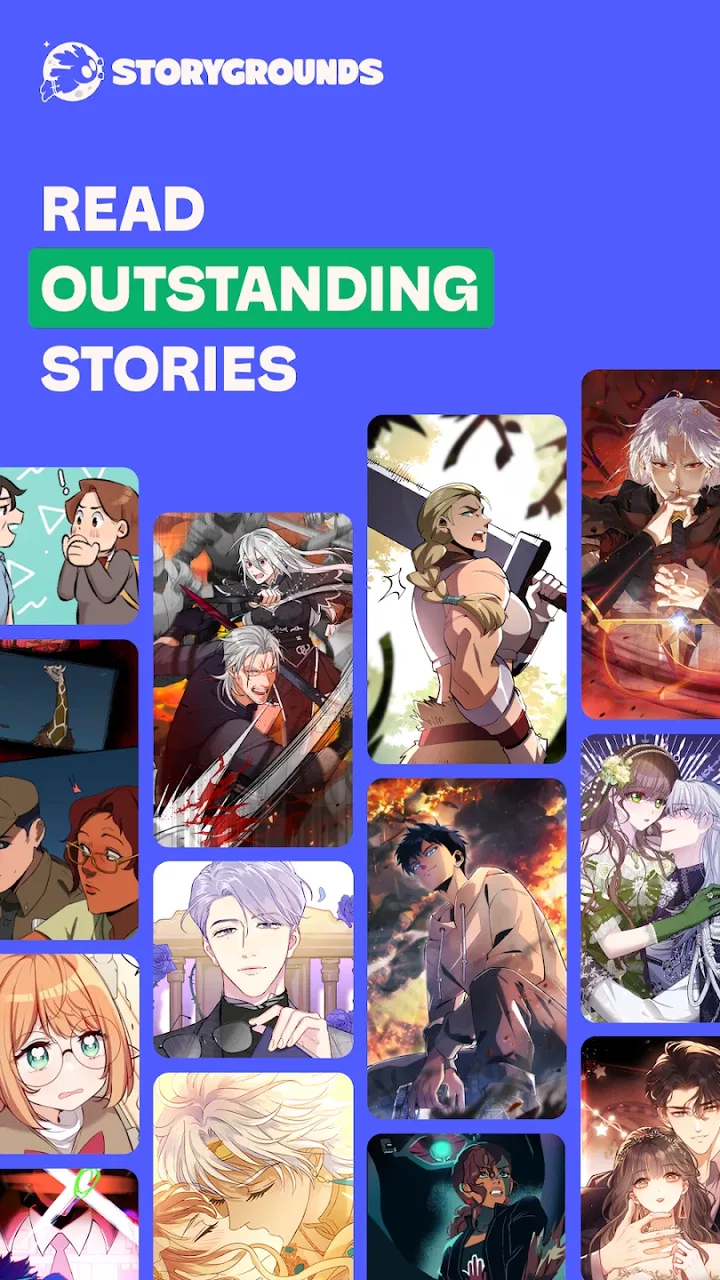
I came away from Storygrounds: Webtoons, Comics with one clear impression: its appeal depends on how much you value having premium comics, webtoons, and manga gathered in one reading-focused app. That sounds simple, but it changes the way I choose what to read. Instead of treating each format as a separate habit, I can move between them from the same place and decide based on mood, artwork, or story length.
That central capability is more useful than the short store description suggests. Storygrounds is a free Comics app from Storygrounds, rated Teen, and it feels aimed at readers who want a dedicated place for illustrated stories rather than a general entertainment application. I would recommend trying it if your reading list already jumps between vertical webtoons, traditional comics, and manga. I would be more cautious if you want a completely free experience with no purchase decisions, or if you prefer a single publisher’s tightly organized catalog.
One library for different kinds of illustrated stories
The strongest idea here is the combination of premium comics, webtoons, and manga. In everyday use, that means I do not have to decide in advance which format I am committed to. A webtoon suits a quick phone session, while a conventional comic or manga chapter can feel better when I have more time and want to settle into page-by-page reading.
You May Also Like

 AccuWeather: Weather Radar
AccuWeather Review: A Quick, Clear Forecast for Everyday Decisions
For everyday plans, the best forecast is the one you can understand quickly. AccuWeather makes rain timing, radar, and local conditions easy to act on, with a few trade-offs.

 Hill Climb Racing
Why Hill Climb Racing Still Turns Crashes Into One More Run
A tiny car, a bumpy hill and one more upgrade: Hill Climb Racing keeps resurfacing because its simple chaos makes every near-miss feel personal.

 AliExpress - Shopping App
AliExpress Makes Global Shopping Feel Personal, but Shoppers Bear the Risk
AliExpress turns a global marketplace into a pocket-sized discovery engine. Its reach is useful, its shopping loop compelling, and its trade-offs easy to miss.

 Lords Mobile: Kingdom Wars
Lords Mobile Is a Kingdom-Building Routine, Not a Quick Match
A case-by-case verdict on the building, battles, device demands, and social commitments that make Lords Mobile rewarding for some players and exhausting for others.

 PDF Scanner app - TapScanner
TapScanner Makes Paperwork Easier to Capture, Check, and Share
TapScanner makes scanning with a phone feel less like a rescue operation and more like a dependable step in getting work done. Its capture tools are useful, though not flawless.

 Block Blast!
 Shows How Much a Puzzle Game Can Leave Out
A quiet grid game shows why puzzle players increasingly value instant clarity, repeatable skill and low-pressure play—and where the genre still needs to catch up.
More From Our News Desk
View All News


That flexibility matters because these formats are not interchangeable. Webtoons are usually designed around vertical scrolling, so they work naturally during a short break. Manga and comics often ask for more attention to panel order, page composition, and visual details. Bringing them together gives the app a broader role than a narrowly focused webtoon reader, but it also makes organization especially important. When several reading styles share one app, the best experience comes from quickly understanding what is available and how each title is meant to be read.
I also like the fact that the app is not presented as a trial-only product. It is free to install, while in-app purchases range from $1.99 to $99.99 per item. That makes the first step easy, but it also means I would approach the catalog with a budget in mind. The practical question is not simply whether the app costs anything to download; it is whether the stories I want can be enjoyed comfortably without purchases and whether paid access feels worthwhile for my reading habits.
The app’s current version is 1.2.5, and it supports Android 7.0 or later. That broad compatibility is helpful for people who keep an older phone as a reading device. It also makes Storygrounds easier to consider for a household where not everyone has a recent handset. I would still judge the experience on the actual screen I plan to use, because comics reveal display limitations more quickly than text-heavy apps do.
Why the combined format matters
For me, the real benefit is discovery across formats. Someone who normally reads manga may find a vertical series that works better for commuting, while a webtoon reader may discover that a conventional comic offers a denser visual rhythm. The app’s value grows when I use it as a bridge between those habits rather than as a replacement for every other reading service.
There is also a useful trade-off in having variety close at hand. I am less likely to abandon reading altogether when the app gives me different ways to continue. If I am tired, a visually direct webtoon may be easier. If I want to slow down, a manga or comic can provide a more deliberate session. That is a small but meaningful advantage over an app built around only one presentation style.
At the same time, variety can make the catalog feel less focused. Readers who already know exactly which publisher, author, or franchise they want may find a specialist service more efficient. Storygrounds makes more sense for exploration and format-hopping than for someone who wants one very specific ecosystem.
What using it feels like in practice
My practical approach would be to treat the app as a reading shelf, not as a place to rush through every available title. I would begin with one webtoon and one manga or comic, then compare how each fits into my routine. That simple test reveals more than browsing endlessly: it shows whether the app’s selection matches my tastes and whether its purchase structure feels comfortable.
For vertical reading, I would use a short session to judge whether the pacing feels natural on my phone. A good webtoon should let the space between panels guide the eye without making me constantly adjust my position. For page-based material, I would read somewhere with a larger screen or enough time to zoom and inspect artwork. This is one of my more important tips: choose the format according to the situation, not just the genre.
A realistic example would be a weekday commute. I might open a webtoon before leaving, read a small portion while waiting, and stop at a natural pause rather than trying to finish a whole chapter. Later, at home, I could switch to manga or comics when I have the attention to follow detailed panel layouts. That workflow is where the multi-format design earns its place. It turns the same app into a quick-break reader and a longer-session reader without forcing both experiences into one layout.
I would also avoid making a large purchase immediately. Since individual in-app items can reach $99.99, a careful reader should first establish how often they return, which formats they prefer, and whether the available stories justify spending. Starting free is not merely a way to save money; it is a way to learn the app’s rhythm before committing to a large catalog purchase or repeated smaller payments.
The Teen content rating is another practical consideration. I would not install it for a child without checking the specific titles being read and using the device’s own purchase controls where appropriate. A rating at the app level is useful guidance, but comic catalogs can contain very different tones and themes from one series to another. Adults choosing it for themselves have less to worry about, while families should treat the rating as a starting point rather than a complete content filter.
A better way to test the app
Instead of asking whether Storygrounds has “enough” comics after a few minutes, I would test three reading situations: a brief vertical session, a focused page-by-page session, and a browsing session where I am not sure what I want. These tests reveal different strengths. The first checks convenience, the second checks whether the app suits longer reading, and the third checks whether its mixed catalog helps discovery or simply creates choice overload.
Another useful habit is to keep a small mental distinction between “I like this story” and “I like this app for this story.” A title may be enjoyable while the broader service still feels less suitable than a specialist reader. Separating those judgments helps me decide whether Storygrounds deserves a regular place on my phone or is better used occasionally for particular formats.
I would also pay attention to how often I switch formats. If I repeatedly move from manga to webtoons and back, the unified approach is doing real work. If I only use one format and already have a trusted alternative, Storygrounds may not add enough convenience to justify changing habits. That is a non-obvious strength of the app: its success is tied less to one spectacular feature than to whether its range matches the way I actually read.
The best scenario for Storygrounds
The ideal user is someone who reads on a phone in changing circumstances. Maybe you follow a vertical series during short breaks, read manga in the evening, and occasionally want a conventional comic without installing another service. For that person, the app reduces friction between reading moods. I would especially consider it for a reader who is curious about formats outside their usual comfort zone.
It also suits people who want a free starting point before deciding how much to spend. The app can be explored without an upfront purchase, which gives a new reader room to understand the catalog and reading experience. The important discipline is to treat the free entry as an evaluation period rather than assuming every desirable title will remain available without payment.
Another strong scenario is travel or waiting time, provided the reader is comfortable using a phone as the main screen. Webtoons can fit naturally into fragmented time, while longer comics can fill a quieter stretch. I would prepare by choosing what I want to read before the moment arrives, because browsing when I have only a few minutes can consume the time I intended to spend reading.
Storygrounds may also appeal to a reader whose tastes are still developing. Someone who says “I like comics, but I do not know which kind” can use the mix of comics, webtoons, and manga to identify preferred pacing and presentation. That discovery process is more valuable than simply having a large number of titles. It helps answer a personal question: do I want the fast visual flow of a webtoon, the structured pages of manga, or the broader panel design of comics?
When another option may be better
I would skip it if my priority were a highly specialized catalog with a familiar publisher, creator, or franchise. A dedicated service may offer a clearer path to that exact material, while Storygrounds’ broader identity is better suited to readers who appreciate variety. I would also hesitate if I dislike in-app purchases on principle. Free installation does not remove the need to think about spending, especially when the purchase range extends from small items to a much larger single purchase.
It is not the obvious choice for a child’s independent reading either. The Teen rating means parents should stay involved, review individual choices, and secure purchases on the device. For an adult reader, that is a manageable consideration; for a family seeking a simple child-friendly library, a more tightly curated alternative may be easier.
Finally, readers who want a large-screen, print-like experience may prefer a tablet, an e-reader designed for comics, or physical editions. Storygrounds is convenient because it travels with a phone, but portability and visual comfort are not the same thing. Detailed artwork deserves a screen that does not make me squint or constantly reposition the page.
Trade-offs that shape the decision
The biggest trade-off is breadth versus focus. Having three major illustrated formats together is convenient, but it can also make the app feel less specialized than alternatives built around one reading style. I see that as a good exchange for exploratory readers and a poor one for readers with a narrow, established routine.
The second trade-off is free access versus paid depth. I like being able to start without paying, yet the purchase range means I would not treat the app as an unlimited free library. A sensible workflow is to sample first, identify the titles that genuinely hold my attention, and then spend selectively. That approach protects against buying simply because a story looks attractive during a quick browse.
There is also a screen trade-off. A phone is excellent for convenience, particularly with vertical webtoons, but less ideal for intricate page layouts. I would not judge every format by the same standard. If a webtoon feels comfortable while a dense manga page feels cramped, that may be a limitation of the device rather than the app itself. Still, the user experience is ultimately about the device in my hand, so the distinction does not make the discomfort disappear.
The Teen rating adds another layer of responsibility. It does not make the app unsuitable for adults, but it does mean I would not hand it to a younger reader without supervision. That is especially important in a mixed catalog, where the tone can vary widely between titles even when the app itself has one overall age label.
Its audience size gives some context without deciding the issue. Storygrounds has passed 10K+ installs, with a 4.8 average from around 340 ratings and 28 reviews. I read that as encouraging early interest, not as proof that it will suit every reader. A smaller community can mean the app is still developing, so I would base my decision on how well its core reading concept fits me rather than on popularity alone.
Who gains the most from the app
I think the biggest winners are flexible readers who dislike maintaining separate apps for separate comic formats. If I regularly alternate between webtoons, manga, and comics, the unified library can simplify my routine and make spontaneous reading easier. It is also a good match for someone who wants to experiment before settling on a preferred format.
Readers on older compatible Android devices may appreciate that the minimum requirement is Android 7.0. That does not guarantee identical performance on every phone, but it keeps the app within reach of people who are not using the newest hardware. I would still leave enough storage and test the reading experience on my own device before making Storygrounds my main library.
The app is less compelling for someone who wants one predictable, purchase-free source or a tightly controlled family catalog. It is also not my first recommendation for a reader who values physical pages, a large display, or a single specialist publisher above all else. Knowing that early prevents disappointment: Storygrounds is about joining formats and discovering stories, not about being the perfect answer for every kind of comic reader.
My final view is positive but measured. Storygrounds: Webtoons, Comics has a clear reason to exist: it lets me move between different forms of illustrated storytelling without changing my reading destination. The free entry makes it easy to explore, while the Teen rating and in-app purchase range call for sensible judgment. I would install it for variety, test it across short and long reading sessions, and spend only after finding titles I genuinely want to continue. For a format-curious reader, that is a worthwhile proposition; for a specialist or strictly free reader, another option may fit better.
FAQs for Storygrounds: Webtoons, Comics
01What types of content can I find on Storygrounds: Webtoons, Comics?
Storygrounds offers a diverse range of webtoons and comics across various genres like fantasy, romance, horror, and slice of life. Whether you enjoy dramatic storylines or light-hearted adventures, there is something for every reader. Additionally, the app frequently updates its library, ensuring fresh content for users.
02Is Storygrounds: Webtoons, Comics free to use?
Yes, Storygrounds is free to download and offers a selection of comics and webtoons at no cost. However, there might be premium content or episodes that require in-app purchases or a subscription. This model allows users to support creators while enjoying exclusive features and content.
03How often is new content added to the app?
New content is added regularly to keep the reading experience fresh and exciting. Updates can vary by title, with some webtoons and comics releasing new episodes weekly, while others may have different schedules. Enabling notifications will ensure you never miss an update from your favorite series.
04Can I read offline on Storygrounds: Webtoons, Comics?
Yes, the app offers an offline reading feature. You can download episodes of your favorite webtoons and comics for offline reading, which is perfect for when you're on the go or in areas with limited internet access. Make sure to download content in advance to enjoy uninterrupted reading.
05Does Storygrounds support multiple languages?
While primarily available in English, Storygrounds is gradually expanding its language support. Some popular titles may be available in other languages, and the app is working on increasing its multilingual offerings to cater to a broader audience. Check the app settings for available language options.
Pros
- Intuitive and user-friendly interface.
- Vast library of diverse comics.
- Offline reading mode available.
- Regular updates with new content.
- Support for multiple languages.
Cons
- Ads can be intrusive at times.
- Limited free content access.
- Occasional app crashes reported.
- In-app purchases can be pricey.
- Requires internet for some features.

Storygrounds: Webtoons, Comics
Gallery